

Your plug-in heater has run for two hours and you can still see your breath over the workbench. The heater isn’t broken. A 120V unit hits a hard power limit, and in a Canadian garage that limit shows up fast.
A 120V garage heater is capped at about 1,500 watts, roughly 5,100 BTU per hour. That warms a person at a workbench, not a whole garage in January. A 240V heater, such as a 6,000W unit, puts out four times the heat but needs a dedicated, hardwired circuit installed by an electrician. Insulation decides whether either one works.
Why does a 120V garage heater top out at 1,500 watts?
A 120V heater is limited by the outlet, not the heating element. At 1,500 watts it draws 12.5 amps (1,500 ÷ 120), which is most of what a standard 15-amp household circuit can carry for hours at a time. Manufacturers stop there so the heater can plug into an ordinary wall outlet.
In a garage, that circuit is rarely yours alone. Garage outlets often share a circuit with the door opener, lights, a compressor or a shop vac. Start the compressor while the heater runs and the breaker trips.
The second limit is output. 1,500 watts converts to about 5,100 BTU per hour (1 watt = 3.412 BTU/h). For scale, one Winnipeg owner reported that a 60,000 BTU propane heater barely made his uninsulated garage bearable at -20°C. A 1,500W plug-in delivers under a tenth of that heat.
How much more heat does a 240V garage heater give you?
Doubling the voltage lets a heater draw far more power on a circuit built for it. Most 240V garage heaters run from 3,000 to 10,000 watts. A 6,000W heater on 240V draws 25 amps and produces about 20,500 BTU per hour, four times a 1,500W plug-in.
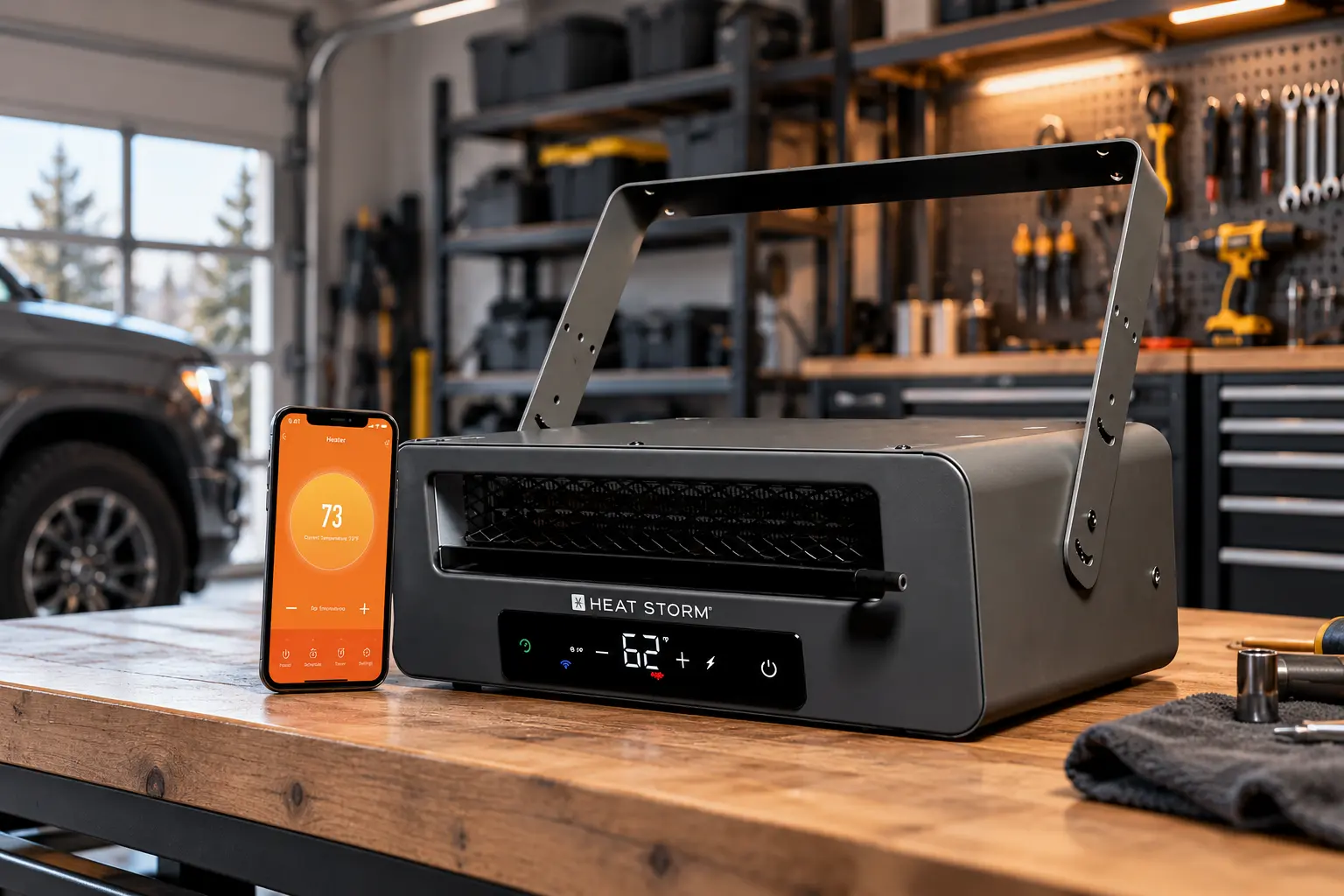
The Heat Storm 6,000W garage heater is a typical example. It mounts on a wall or ceiling, runs on a built-in thermostat, and must be hardwired to a 240V circuit. Heat Storm rates it for spaces up to 1,000 sq ft; treat that as a best case for a well-insulated garage, not a promise for a drafty one.

| 120V plug-in | 240V hardwired | |
|---|---|---|
| Typical max output | 1,500 W (about 5,100 BTU/h) | 3,000 to 10,000 W (about 10,200 to 34,100 BTU/h) |
| Current at full power | 12.5 A at 1,500 W | 25 A at 6,000 W |
| Circuit | Standard outlet, often shared | Dedicated double-pole circuit |
| Install | Plug in | Electrician, usually with a permit |
| Best job | Spot heat for one person | Heating the whole garage |
Is a 240V garage heater cheaper to run than a 120V heater?
No. Every electric resistance heater turns close to 100% of its electricity into heat, at either voltage. A kilowatt-hour costs the same whether it flows through a 120V or a 240V circuit, so 1,000 watts of heat costs the same per hour either way.
The real cost difference comes from run time. An undersized 1,500W heater in a big or cold garage may never reach the thermostat setting, so it runs nonstop. A 6,000W heater reaches temperature, then cycles off. Illustrative math: a 1,500W heater running 10 hours uses 15 kWh. A 6,000W heater that runs a quarter of those 10 hours uses the same 15 kWh, and the garage is actually warm. Multiply kWh by the rate on your hydro bill for your own number.
What do Canadian garage owners actually report?
Canadian forum posts show the same pattern: plug-ins work for spot heat, 240V units heat the room, and insulation decides everything. In our review of Canadian garage-heating threads on Reddit and RedFlagDeals, insulation came up in 161 separate posts as the factor that made or broke a heater.
| Garage | Heater | Owner’s result |
|---|---|---|
| Small insulated garage, Ontario | 5,000 W electric | Keeps it comfortable |
| Detached garage, Ottawa | 5,000 W electric | Holds about 64°F (18°C) |
| Garage, Winnipeg | 7,500 W on 240V, 40 A breaker | Owner stresses the dedicated circuit |
| Uninsulated 1.5-car, cement pad | Radiant oil plug-in | “Didn’t even make a dent” |
| Hamilton garage, hockey nights | 1,500 W infrared, 120V | Warm if switched on an hour early |
The last row matters. A 120V infrared heater aimed at where you sit works. A 120V heater asked to warm the whole room in an uninsulated space does not.
Which garage heater should you buy?
Match the heater to the job, not the price tag. Use your garage size, its insulation and the outlets you already have.
| Your situation | Pick | Why |
|---|---|---|
| One person at a workbench, any garage, only 120V outlets | 120V infrared, mounted or portable | Infrared warms you and your bench directly, so drafts matter less |
| Insulated single garage, occasional use, mild cold | 120V 1,500 W | Workable if you accept a slow warm-up |
| Insulated one- or two-car garage, hours of use in winter | 240V, about 5,000 to 7,500 W | Reaches temperature and holds it on a thermostat |
| Uninsulated garage, -20°C nights | Insulate first, then size the heater | Heat escapes faster than either voltage can add it |
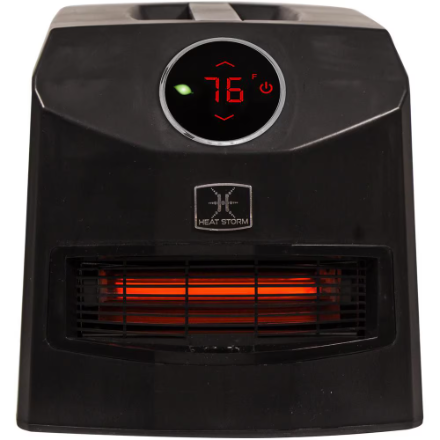
For spot heat, the Heat Storm Tradesman 1,500W infrared heater mounts on a wall or ceiling above the bench and runs on a remote. Portable options like the Heat Storm Mojave move with you. Compare the full lineup on our Heat Storm heaters page.
What does installing a 240V garage heater involve?
A 240V garage heater needs its own double-pole breaker, wire sized to the heater’s manual, and a hardwired connection. Your panel needs spare capacity and two open breaker slots. Most homeowners hire a licensed electrician for this work.
Three things to check before you order:
- Panel space and capacity. Open the panel door and look for two free slots. An older 100-amp panel with electric appliances may not have room for a 25-amp load.
- Distance to the garage. A detached garage needs a feed run from the house, which adds the most cost.
- Permit. A new circuit usually needs a permit and inspection through your provincial electrical safety authority (ESA in Ontario). Your electrician typically files it.
Ask for a quote before you buy the heater, so the total cost is clear up front.
When is a 120V plug-in heater the right call?
A 120V heater is the right pick when you need heat on you, not in the whole room. That covers a renter who can’t add a circuit, a short session at the bench, or keeping a small corner above freezing.
Three rules keep a plug-in safe and useful:
- Plug straight into the wall. Skip extension cords; a 12.5-amp load heats thin cords.
- Give it its own circuit if you can. Unplug the compressor and shop vac while the heater runs.
- Keep clearance. Keep sawdust, rags and solvents away from the heater. Closed garage storage cabinets help in a workshop.
What else should you plan for in a heated Canadian garage?
Heat melts the snow and road salt you drive in. Several Canadian owners say that salty meltwater speeds up rust on cars parked inside, so plan for drainage or a floor mat that holds meltwater. Combustion heaters add moisture too; electric heaters add none, one reason many owners choose them for an attached garage.
FAQ
Is a 240 volt heater more efficient than a 120 volt heater?
No. Both turn close to 100% of their electricity into heat, and a kilowatt-hour costs the same at either voltage. A 240V heater feels more efficient because it delivers more watts, reaches the set temperature and then cycles off, while an undersized 120V heater may run all day without getting there.
Can I run a 240V heater on 120V?
No. A heater built for 240V puts out only about a quarter of its rated heat on 120V, because output falls with the square of the voltage. Its thermostat and controls may not work either. Install the 240V circuit the heater calls for, or buy a 120V model.
Is 120V better than 240V for a garage?
120V is better for spot heat: no install, no permit, and you can move it. 240V is better for heating the whole garage, since it delivers three to six times the output. Pick by job: heat on you, choose 120V infrared; heat in the room, choose 240V.
What type of heater is best to heat a garage?
For an insulated, attached garage you use often, a 240V electric heater on a thermostat is the simplest option, with no fumes or added moisture. For one person at a bench, 120V infrared works. Natural gas unit heaters also work well but need venting, a gas line and a carbon monoxide detector.
How many watts do I need for a two-car garage?
It depends on insulation, door seals and how cold your winter gets. Canadian owners with insulated garages report good results from 5,000 to 7,500 watts on 240V. An uninsulated two-car garage needs insulation before any electric heater can keep up.
Can I use an extension cord with a garage heater?
Avoid it. A 1,500W heater draws 12.5 amps for hours, which heats a light-duty cord and its plug. Plug the heater directly into a wall outlet, and keep other tools off that circuit while it runs. A 240V heater is hardwired, so cords never apply.
Heat the garage you actually have
Spot heat over the bench or 6,000 watts for the whole garage. Compare Heat Storm heaters by wattage, voltage and mounting.
Not sure which fits? Send us your garage size and outlet type and we’ll point you to the right unit.
